

Criterion 01
The size of the site
Area, traffic and power requirements
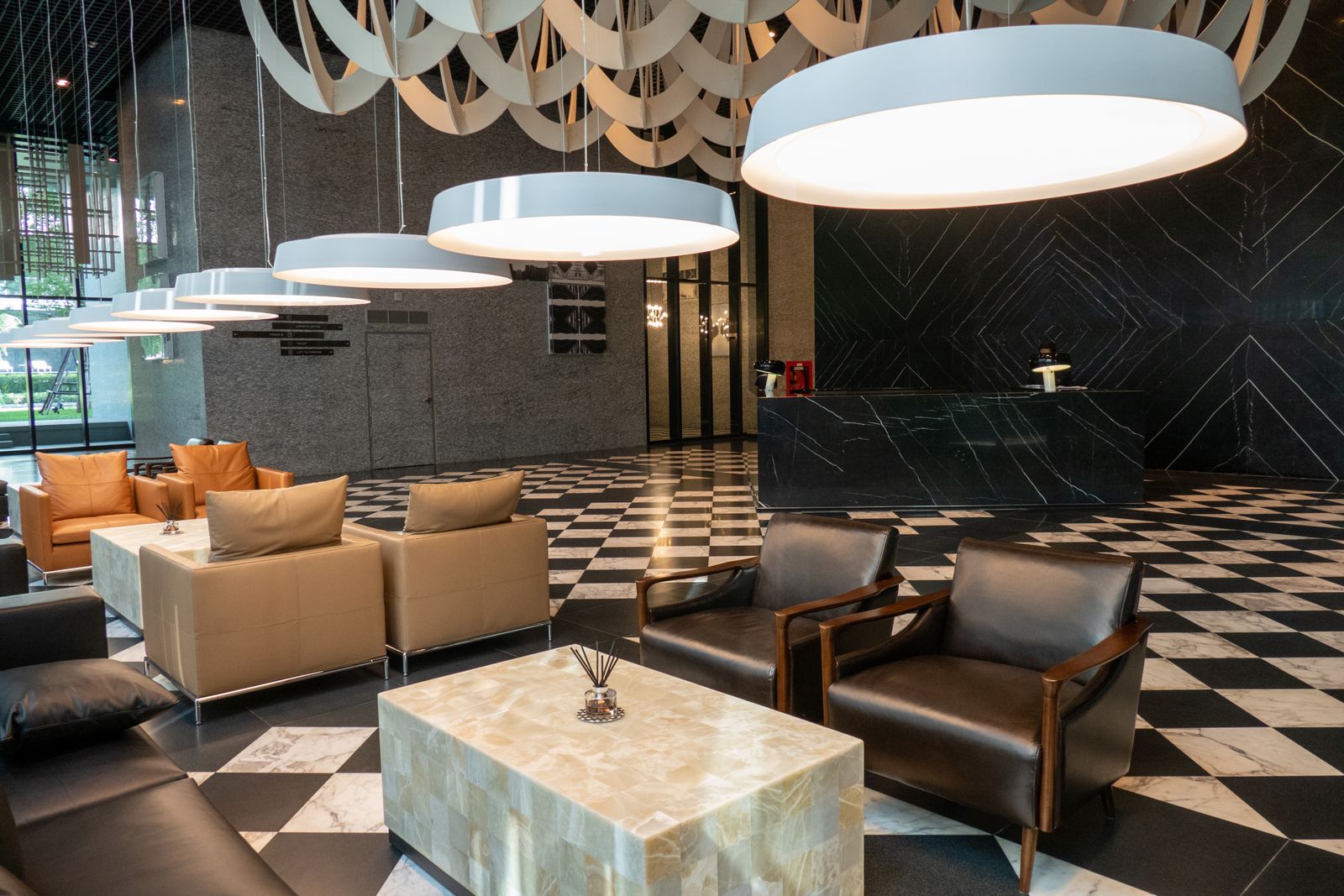
The size of your establishment is an important factor in the amplification power required. But beware: it’s not just a question of square meters. Several factors come into play, as we’ll see below. The fact remains that the larger the space, the more loudspeakers you need to ensure even coverage, and therefore the more power you need to drive them.
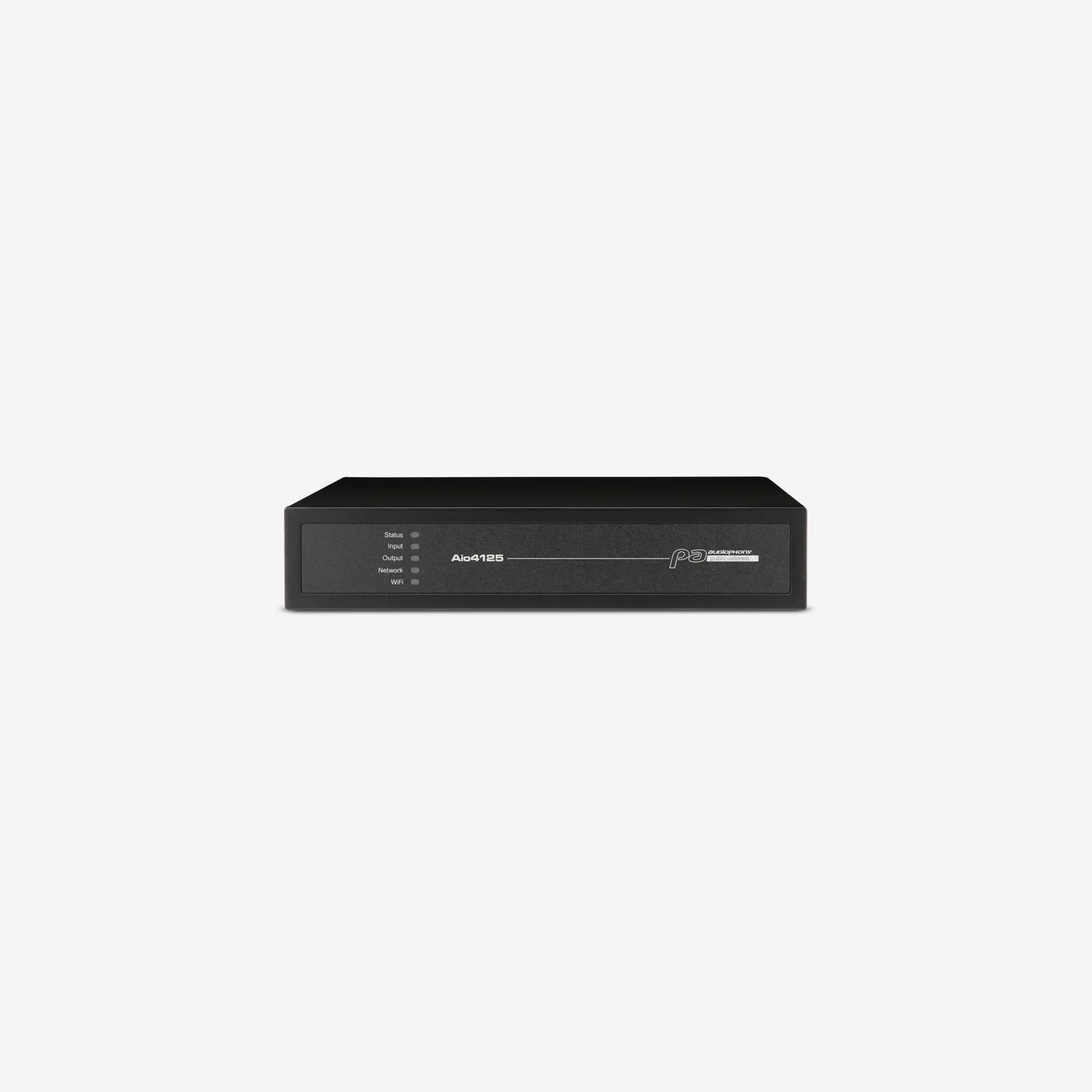
An amplified matrix like theAio4125 offers 4 outputs of 125 Watts at 4 Ohms, which means it can deliver over 60 Watts of power to 8 8-Ohm loudspeakers like the Onde660, for example. It’s enough to cover a large surface area in a restaurant, hotel lobby or hospital waiting room, while ensuring good loudspeaker distribution and homogeneity.
The Aio4125 is the smallest matrix amplifier in the range, so if you need another model, it may be that you need to cover more space, or that your requirements are more in the area of sound performance.

Criterion 02
Volume and performance
When use defines the material required, and vice versa

The volume required also depends on the use you make of your sound system. A restaurant, a bar with an occasional DJ, or a karaoke club, do not have the same needs in terms of sound pressure. For background music, choose a large number of points for the most homogeneous coverage possible. And in the case of higher-volume musical entertainment, create close zones with high sound pressure and rest areas where the atmosphere is calmer. Another example is the gym, which has rooms dedicated to rhythmic, high-volume activities, but also large areas that are much more restful for the ears.
In the latter case, you need not only a real reserve of power to switch from one ambience to another, but also advanced multi-zone management. An Aio4500 matrix amplifier enables just this kind of variation, thanks in particular to its ability to deliver up to 4×500 Watts RMS. For quiet areas, combine it with an Aio4125 or Aio8125.

Amplified matrix – High power
Aio4500
High-power 4×4 matrix, 4×500W @ 4Ω, Bridge 2×1000W, 2U rack.
Criterion 03
Zoning, the key to success
To each his own source, to each his own volume

A zone corresponds to a space where you wish to control volume and source independently of other spaces. With matrix amplifiers, each input can be sent to each output, alone or through a mix of several sources. And each zone can enjoy a separate volume, even going so far as to control each speaker independently. On the contrary, you may want all zones to share the same characteristics at any given time.
In your project, you therefore need to determine how many zones need to be independent, and whether they need to be monitored separately at all times. Aio’s amplified matrices allow a wide range of configurations, and are ideal for complex projects that also include general matrices. All you have to do is count the zones and control points to find out which configuration is right for you.
Criterion 04
Day-to-day control
From installation to use
Aio matrix amplifiers offer several levels of control to suit both the everyday user and the installer responsible for configuration. For example, you can play the simplicity card and provide access to volume and source via a dedicated wall-mounted controller like the AioCTL. You can also offer more advanced control from a smartphone, tablet or computer, taking advantage of the HTML5 interface of Aio matrices.
In all cases, it’s up to the installer to manage the level of user involvement, and therefore the need for training. This is not at all necessary when using AioCTL, but can be an advantage when advanced control is required. Particularly on sites where zones, enclosures and modes of use are multiplying.
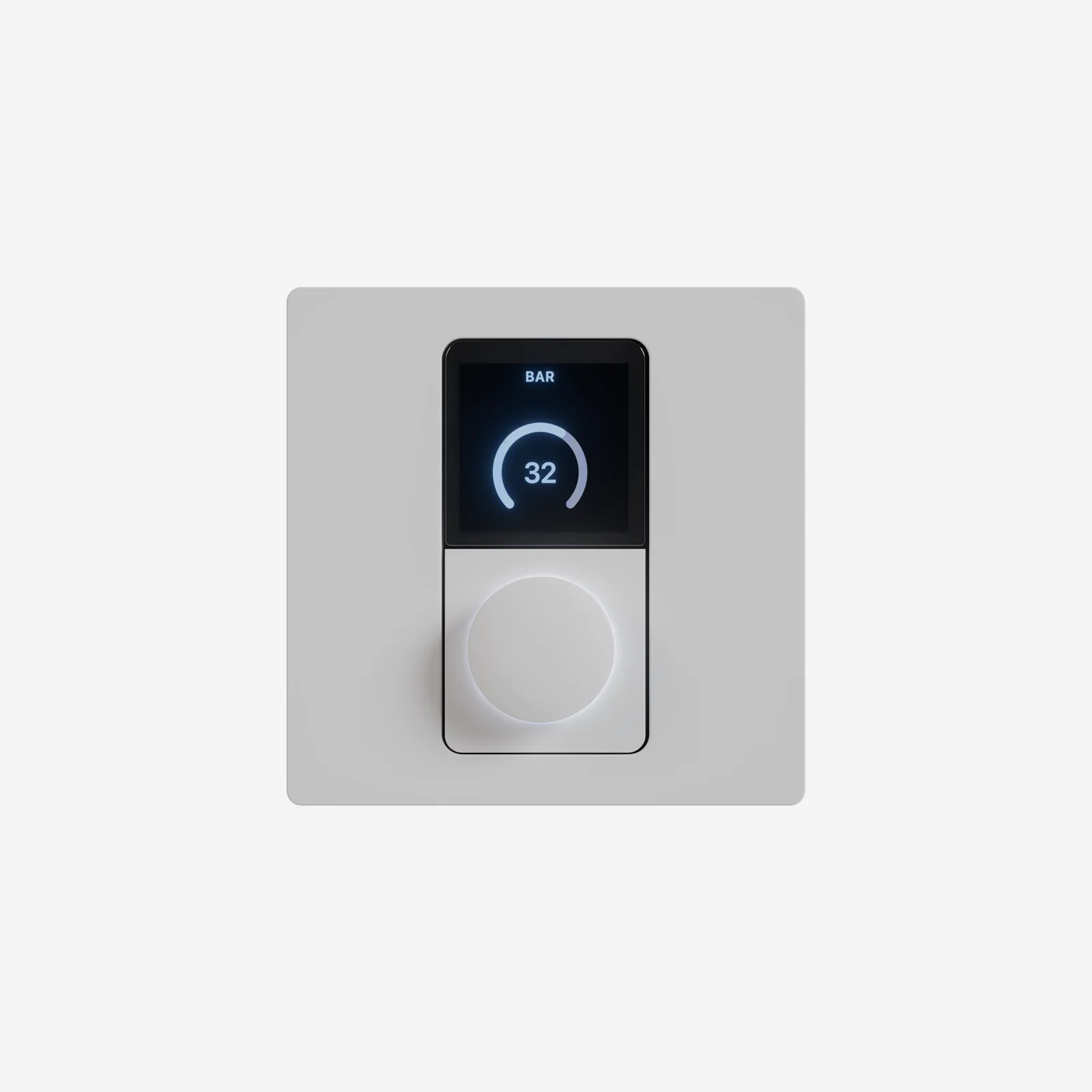
Wall controller – PoE – White
AioCTL
Multi-zone wall controller, display + rotary encoder, PoE power supply.
Example of installation with 3 zones
Criterion 05
In and out
When sources and speakers multiply

On a fixed installation, you may need a large number of speakers and sources. Fortunately, Aio matrix amplifiers have been designed to adapt to any type of configuration. While they offer from 4 to 8 simultaneous inputs (line or microphone level), which is generally sufficient, they can also be used with mixing desks or even general matrixes to increase their possibilities.
Better still, when faced with a multiplication of zones or loudspeakers, or even with specific needs for different types of loudspeaker, these matrix amplifiers prove to be particularly effective. They can thus be considered as simple multi-channel amplifiers, with numerous possibilities: management of satellites as well as subwoofers, amplification of low impedance speakers in 16, 8 or 4 Ohms as well as in high impedance 70V or 100V. All with several levels of DSP offering compression, equalization, delay, etc.
Selection assistance
Which model to choose?
Compare the 3 Aio models at a glance
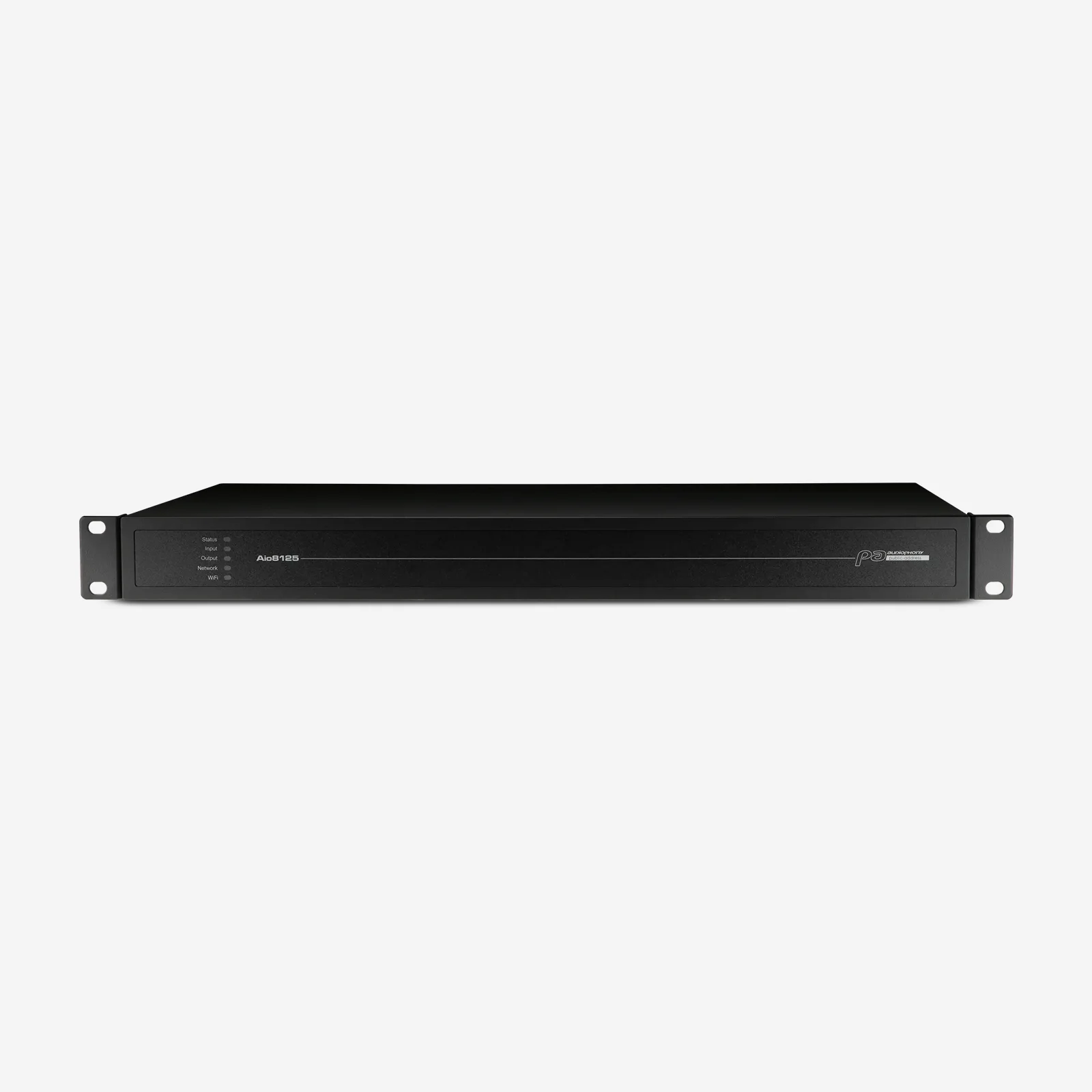
| Model | Aio4125 | Aio4500 | Aio8125 |
|---|---|---|---|
| Zones / Outputs | 4 | 4 | 8 |
| Simultaneous inputs | 4 | 4 | 8 |
| Lo-Z power (4 Ω) | 4 × 125 W | 4 × 500 W | 8 × 125 W |
| Bridge BTL (8 Ω) | 2 × 250 W | 2 × 1000 W | 4 × 250 W |
| Hi-Z 70 / 100 V | 2 × 250 W | 2 × 1000 W | 4 × 250 W |
| DSP matrix | 4 × 4 | 4 × 4 | 8 × 8 |
| Rack format | 1U half-width | 2U | 1U |
| Weight | 2.8 kg | 7.4 kg | 3.5 kg |
| Modules | Pascal UMAC™ Class D – Web HTML5 – Ethernet RJ45 + WiFi – S/PDIF – GPIO 8 pins | ||
| Price incl. VAT | 1 299 € | 2 599 € | 2 499 € |
In a nutshell
Aio matrix amplifiers can be used in all types of installation
In the case of small installations, simply count the sources and loudspeaker outputs to find the Aio model that best suits your needs. If the installation requires more inputs or outputs than a single matrix can provide, simply combine several models to suit your needs. The SPDIF digital input and output system ensures lossless source or mix transfer.
For larger installations, use Aio matrixes as multi-channel amplifiers with integrated DSP. Combined with mixers and input matrices, these matrices will simplify your installations, offering power, control and adaptability.
And of course, as always with Audiophony PA, don’t hesitate to contact us at any stage of your project. We’ll be delighted to give you all the information you need, and, if necessary, to refer you to the professionals best placed to look after your future installation.
Do you have an installation project to consider? Contact the Audiophony PA team →